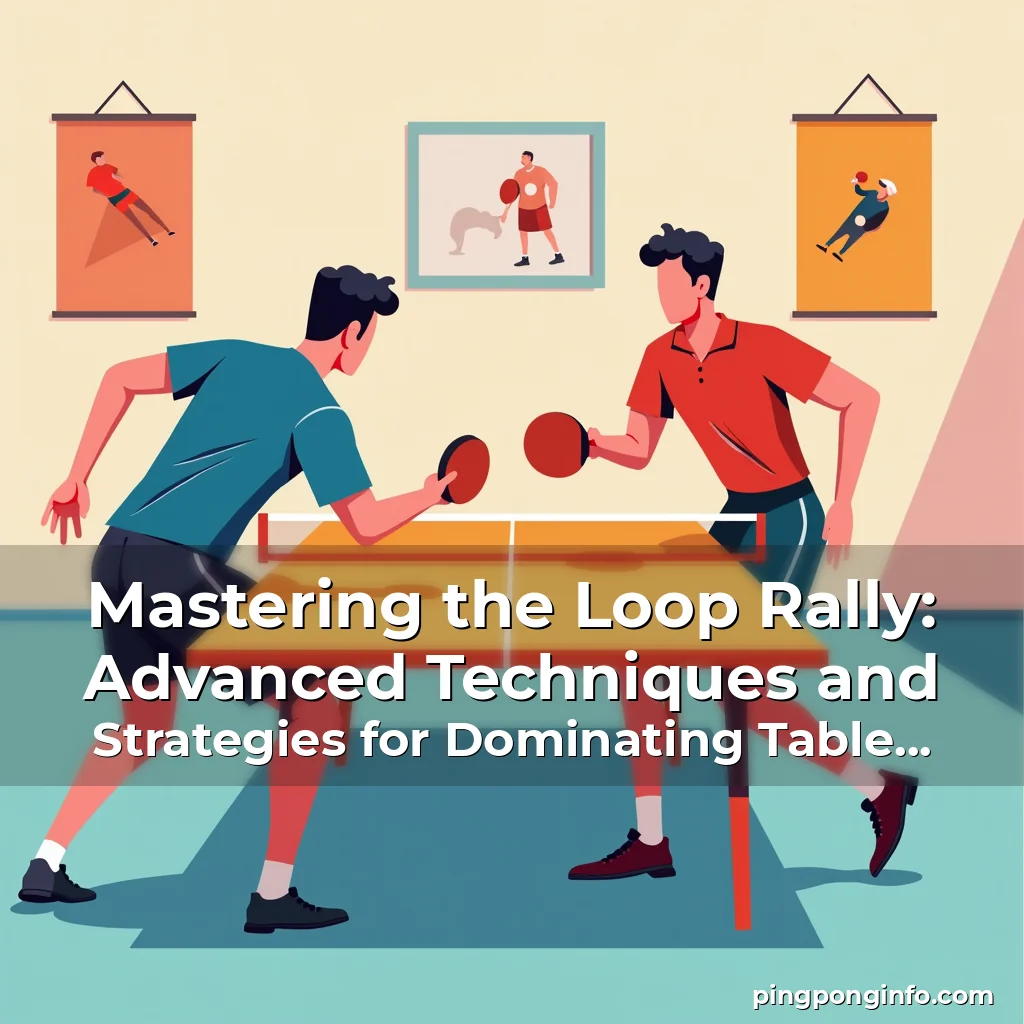
Mastering the Loop Rally: Advanced Techniques and Strategies for Dominating Table Tennis
The loop rally stands as one of the most dynamic and strategically significant aspects of modern table tennis. Unlike traditional blocking or pushing styles, the loop rally emphasizes powerful topspin strokes that force opponents into defensive positions while creating scoring opportunities through precision and timing. Whether you’re competing in local tournaments or aiming for international recognition, mastering this technique is essential for elevating your game.
This guide delves deep into the mechanics, training methods, and psychological nuances required to excel in loop rallying. We’ll explore everything from foundational setups to advanced tactical applications, ensuring every player—from novice to elite—can refine their approach and gain a competitive edge.
The Fundamentals of a Successful Loop Rally
A successful loop rally begins with a solid understanding of the physical and technical principles behind effective topspin generation. At its core, the loop involves striking the ball with a forward-and-upward motion, adding heavy topspin to create high arcs that land deep within the opponent’s court. This requires precise contact with the ball’s equator and controlled follow-through.
Mastery of body mechanics is critical. Proper stance, weight distribution, and coordination between arms and legs allow players to maintain stability while executing rapid, consecutive loops. Beginners often underestimate the significance of lower-body engagement, which provides the explosive power necessary for sustained rallies.
- Stance Position: Feet shoulder-width apart, knees slightly bent, center of gravity low. This setup enables quick lateral movement and maintains balance during intense exchanges.
- Grip Technique: Using a shakehand grip ensures optimal control and flexibility for generating topspin without sacrificing speed. Adjustments may vary based on individual preference and playing style.
Consistency in stroke mechanics prevents fatigue and minimizes errors during prolonged rallies. Practicing slow-motion repetitions helps internalize muscle memory before progressing to full-speed scenarios.
Footwork Dynamics in Loop Rallies
Excellent footwork forms the foundation of any dominant loop strategy. Without fluid movements across the table, even the best-loved strokes become ineffective. Players must develop the ability to recover quickly after each shot, repositioning themselves optimally for the next exchange.
Specific drills targeting side-to-side shuffling, crossover steps, and diagonal transitions help build agility and responsiveness. For instance, practicing “zigzag” patterns along the baseline reinforces lateral mobility, enabling quicker access to wide shots near the edges of the table.
Statistical Insights on Professional Movement Patterns
An analysis of ATP world tour events reveals that top-ranked players cover approximately 8–10 meters per rally compared to amateurs who typically manage only half that distance. This highlights the importance of efficient footwork in sustaining high-level performance throughout extended match durations.
Furthermore, studies indicate that athletes employing hybrid step sequences—combining small hops with sliding motions—exhibit improved reaction times by roughly 15% versus those relying solely on static stances. Integrating such varied approaches into regular practice routines significantly boosts overall effectiveness.
Psychological Factors Influencing Loop Performance
Beyond physical preparation lies another dimension crucial to success: mental resilience. High-pressure situations demand unwavering concentration, especially when attempting complex combinations or facing aggressive counterattacks. Developing composure amidst adversity separates champions from contenders.
Visualization techniques prove invaluable here. Imagining ideal outcomes prior to executing critical shots primes the mind for success. Additionally, cultivating awareness of an opponent’s tendencies aids in predicting responses during intense moments, allowing strategic adjustments mid-game.
Coping mechanisms such as deep breathing exercises and mindfulness practices contribute positively towards managing stress levels effectively. By incorporating these tools regularly, players enhance their capacity to perform consistently under duress.
Optimizing Equipment Selection for Enhanced Loops
Selecting appropriate gear plays a pivotal role in maximizing loop potential. While personal preferences dictate choice, certain factors remain universally beneficial regardless of skill level. Understanding these variables empowers players to tailor selections according to individual needs and goals.
Racket composition affects both power output and maneuverability; carbon fiber blades offer increased stiffness leading to faster blade response whereas composite materials provide greater forgiveness suitable for developing players. Ball type also matters—the newer plastic-based ones produce less friction than older celluloid models, altering spin dynamics subtly yet notably.
Grips influence control capabilities dramatically. Though many opt for standard shakehands grips due to versatility, alternatives like penhold or reverse grips cater specifically toward specialized looping styles requiring heightened wrist action. Experimentation with various options identifies what works best personally.
Common Pitfalls Hindering Effective Loop Execution
Despite rigorous training efforts, several recurring issues impede progress among aspiring loop specialists. Identifying and addressing them early prevents unnecessary setbacks later on. Awareness serves as the first line defense against stagnation.
One prevalent mistake involves overextending limbs excessively during strokes, resulting in loss of form integrity. Maintaining compact arm movements preserves accuracy while conserving energy reserves crucially needed during multi-point exchanges.
- Incorrect Contact Point: Striking above or below the ball’s equator disrupts natural rotation flow. Ensuring consistent contact height improves reliability and reduces unforced errors.
- Inconsistent Timing: Rushed attempts lead to weak returns lacking sufficient spin. Patience combined with rhythmic breathing establishes steady tempo conducive to accurate looping actions.
Additionally, neglecting warm-ups thoroughly predisposes individuals to injury risks. Comprehensive pre-match preparations involving dynamic stretches and light cardio sessions mitigate muscular strains commonly experienced post-exercise periods.
Tactical Applications of the Loop Rally
Strategic deployment transforms routine loops into formidable weapons capable of dismantling opposition defenses systematically. Recognizing opportune moments to employ this tactic distinguishes skilled competitors from average performers. Tactical acumen becomes paramount once fundamentals reach mastery stage.
Varying angles introduces unpredictability making prediction difficult for adversaries. Targeting corners forces defenders out of comfortable zones reducing margin for error drastically. Furthermore, alternating between fast drives and slower loops creates confusion regarding intended trajectories.
Predatory loops aimed precisely at seams exploit weaknesses inherent in poorly positioned guards. Such calculated aggression exploits gaps left open unintentionally by fatigued opponents struggling to maintain coverage comprehensively.
When to Employ Aggressive vs Defensive Loops
Aggressive looping proves advantageous primarily when exploiting openings created by misjudged blocks or weak pushes. Conversely, defensive variations serve well when seeking time to reset posture following missed opportunities or adverse momentum shifts.
Timing remains integral factor determining outcome. Launching surprise attacks during lulls catches enemies off guard enhancing chances considerably. However, excessive reliance upon this method invites retaliation unless countered intelligently via counter-looping strategies.
Successful integration demands careful observation coupled with swift decision-making abilities. Reading subtle cues exhibited by opponents facilitates timely interventions preventing escalation unnecessarily.
Training Drills Designed Specifically for Loop Mastery
To achieve proficiency, targeted exercise regimens focusing exclusively on refining loop qualities yield superior results compared generalized conditioning alone. Structured programs accelerate development exponentially surpassing passive learning methodologies.
Shadow drilling constitutes fundamental starting point wherein practitioners simulate actual gameplay conditions devoid external stimuli. Focusing intently upon form correction during these sessions ingrains correct biomechanics seamlessly into subconscious processes naturally.
Partner workouts introduce interactive element essential for replicating live competition environments accurately. Engaging actively with fellow trainees sharpens reflexes simultaneously building camaraderie fostering motivation levels inherently.
Suggested Weekly Routine Outline
Monday: Begin with 30 minutes dedicated purely to perfecting forehand loops followed by equivalent duration concentrating backhand counterparts separately. Alternate between slow controlled reps transitioning gradually upwards increasing intensity progressively.
Wednesday: Incorporate cross-court variation training emphasizing angle changes. Spend 20 mins working on corner targeting then shift focus onto mid-table placements ensuring balanced coverage across entire playing area uniformly.
Saturday: Dedicate hour-long session exploring application scenarios applying learned skills realistically against adaptive resistance. Monitor progress closely adjusting difficulty accordingly maintaining challenge appropriately relative current capability level.
Evolving Trends Shaping Modern Loop Tactics
The landscape surrounding contemporary loop strategies continues evolving rapidly influenced largely technological advancements alongside shifting competitive paradigms globally. Keeping abreast latest developments sustains relevance amidst ever-changing standards prevailing today.
Emerging trends emphasize greater emphasis placed upon spin manipulation rather sheer velocity. Innovations facilitating enhanced control now enable intricate layering effects previously unimaginable achievable manually alone. Utilization thereof opens new avenues expression creatively expanding stylistic diversity available modern players.
Digital analytics platforms offer unprecedented insight regarding performance metrics revealing hidden inefficiencies otherwise undetectable visually alone. Leveraging such resources identifies areas needing improvement objectively guiding remedial measures efficiently directed accurately.
Conclusion
The loop rally represents far more than mere technicality—it embodies essence competitive spirit defining table tennis itself. Through diligent study commitment continuous refinement, anyone possesses capacity transform ordinary into extraordinary achieving heights previously thought unreachable.
Remember always: excellence stems not instantaneous brilliance but relentless pursuit perfection. Apply discussed principles diligently persistently until they become instinctual reactions occurring effortlessly under pressure. With steadfast determination guided sound methodology, triumph awaits eagerly ready grasp whoever dares pursue it wholeheartedly.

news is a contributor at PingPongInfo.com. We are committed to providing well-researched, accurate, and valuable content to our readers.